Comparing Gutter Cleaning Techniques: Manual, Blower, and Flush Methods Explained
Most homeowners don’t think about their gutters until water starts pooling where it shouldn’t—near the foundation, along the fascia, or inside the basement. By that point, the damage is often already done.
Gutters do a simple but critical job: they channel rainwater away from your home’s structure. When they’re clogged with leaves, dirt, and debris, that system breaks down. Water overflows, seeps into siding, saturates the soil around your foundation, and can even work its way under your roofline. Over time, this leads to costly repairs that far exceed the cost of routine maintenance.
Cleaning your gutters at least twice a year—typically in late spring and late fall—is one of the most effective ways to protect your home from water damage. But not all cleaning methods work the same way. Depending on your roof type, the volume of debris, and your comfort level working at height, some techniques will suit your situation better than others.
This guide breaks down the three most common gutter cleaning methods—manual, blower, and flush—so you can make an informed decision about what’s right for your home.
Why Seasonal Gutter Maintenance Matters
A well-maintained gutter system protects several parts of your home simultaneously. It keeps water away from your foundation, which is especially important in regions with heavy rainfall or freeze-thaw cycles. It prevents wood rot along your fascia boards and soffits. It reduces the risk of ice dams forming in winter, where trapped water freezes and expands under shingles.
Skipping seasonal cleanings compounds the problem. Debris builds up, gutters start to sag under the weight, and standing water becomes a breeding ground for mosquitoes and mold. In some cases, the gutters pull away from the roofline entirely, requiring full replacement rather than a simple cleaning.
The good news is that regular maintenance is straightforward—and understanding which method to use makes the job faster and more effective.
Manual Cleaning: Thorough but Labor-Intensive
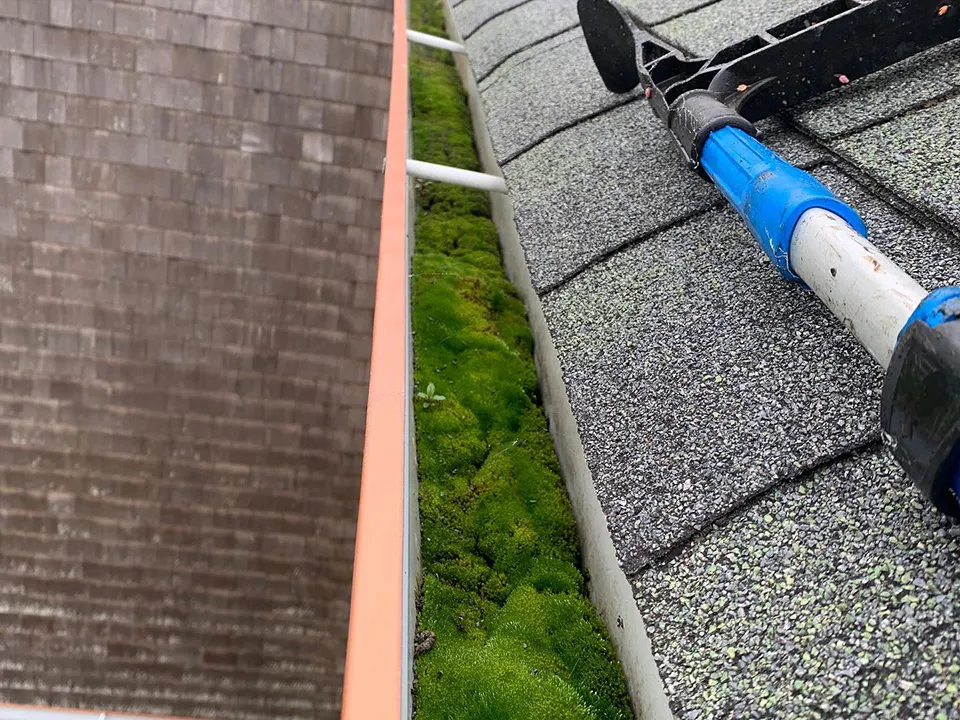
Manual cleaning is the most hands-on approach. It involves physically removing debris from gutters using gloved hands, a small gutter scoop, or a narrow trowel. Workers typically use a ladder positioned at regular intervals along the gutter run, moving it as they go.
Pros of Manual Cleaning
The biggest advantage of manual cleaning is thoroughness. You can feel what you’re removing, which means you’re less likely to miss compacted debris or the fine layer of granules and dirt that accumulates at the bottom of the gutter channel. It also gives you a close-up view of the gutter’s condition—cracks, rust spots, loose brackets, and failing seams are easy to spot when you’re right there.
Manual cleaning works well for gutters with heavy, wet debris loads, such as after a prolonged rainy season or when decomposing leaves have turned into a thick, compacted sludge. Dry methods like blowers simply can’t shift that kind of buildup.
Cons and Safety Considerations
The downsides are real. Manual cleaning is physically demanding and time-consuming, especially on larger homes. The repeated ladder repositioning increases the risk of falls, which is the leading cause of DIY home improvement injuries.
Working safely requires a quality extension ladder rated for your weight, non-slip footwear, and ideally a second person to stabilize the base. Never lean a ladder against the gutter itself—it can bend or crack under pressure. Roof jacks or standoff ladder arms are better options for maintaining safe contact points.
For multi-story homes or steeply pitched roofs, manual cleaning from a ladder becomes significantly more hazardous. This is where professional services with proper equipment and safety protocols provide clear value.
The Blower Method: Speed vs. Thoroughness
The blower method uses a leaf blower—either a standard handheld unit or a specialized gutter attachment—to dislodge and blow out dry debris. Some professionals use backpack blowers with curved gutter nozzles that direct airflow along the channel without requiring the operator to be at the same height as the gutters.
Pros of the Blower Method
Speed is the primary advantage. A blower can clear a standard gutter run in a fraction of the time that manual cleaning takes. For homes surrounded by deciduous trees, this method is particularly useful in fall when gutters fill quickly with dry, loosely packed leaves.
With the right attachment, blowing can be done from ground level or from a ladder positioned away from the gutter, reducing the need to reposition frequently.
Limitations to Consider
The blower method has a significant limitation: it only works well on dry debris. Wet, compacted leaves or sediment buildup won’t budge under airflow alone. Blowing also moves debris rather than removing it—it’s common for leaves to end up on the roof, in the yard, or scattered across garden beds rather than collected for disposal.
More importantly, blowing does nothing to test whether your downspouts are clear. Debris often migrates toward and into downspout openings, and a powerful air burst can actually push material further into the pipe rather than dislodge it.
For these reasons, blowing is best used as an interim method between more thorough seasonal cleanings, not as a complete maintenance solution on its own.
The Flush Method: Testing Downspouts and Finishing Touches
The flush method uses a garden hose with a high-pressure nozzle—or a pressure washer on a lower setting—to wash debris out of gutters and through the downspouts. It’s typically used as a final step after manual or blower cleaning to rinse remaining grit and test drainage performance.
Why Flushing Matters
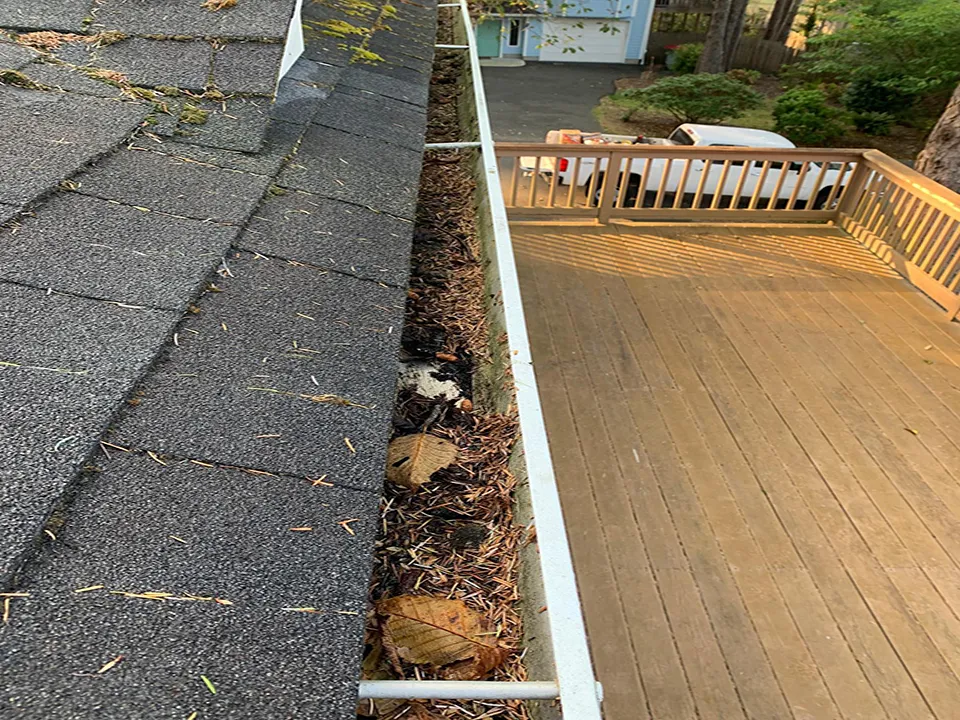
Gutters can appear clean on the surface but still drain slowly due to fine sediment, roof granule buildup, or a partial downspout blockage. Flushing reveals these problems immediately. If water backs up instead of flowing freely toward the downspout, there’s a blockage or a pitch issue that needs attention.
Running water through the full system also lets you spot leaks at seams and joints, and check that water exits the downspout extension far enough from the foundation. A downspout that discharges water directly against the home’s footer is nearly as problematic as a clogged one.
Pressure Considerations
One note of caution: excessive water pressure can force water under shingles or damage older gutters and sealant. A standard garden hose with a spray nozzle is usually sufficient for rinsing. Pressure washing is best reserved for heavily soiled gutters under professional supervision.
Comparing All Three Methods by Roof and Home Type
Different properties call for different approaches. Here’s how the three methods stack up across common scenarios:
- Single-story homes with moderate tree coverage: The blower method handles routine debris removal well. Supplement with a manual clean and flush once or twice a year.
- Multi-story homes: Ladder safety becomes a primary concern. Professional cleaning is strongly recommended. Professionals use industrial vacuums and telescoping wand attachments that allow safe, thorough cleaning from the ground or with proper scaffolding.
- Homes with heavily shaded lots or dense deciduous tree coverage: Manual cleaning is the most reliable option given the volume and moisture content of debris. Blowers won’t be effective on wet, matted leaf buildup.
- Metal roofs and older asphalt shingles: Extra care is needed around granule loss and surface abrasion. Flushing should be done gently, and foot traffic on the roof should be minimized.
- Flat or low-pitch roofs: Water doesn’t drain as efficiently, making regular flushing particularly important to identify pitch problems and pooling zones in gutters.
No single method covers everything. The most effective maintenance programs combine all three in sequence: manual removal of bulk debris, blowing out loose residue, and flushing to test the full drainage system.

Why Professional Equipment and Expertise Make the Difference
DIY gutter cleaning is feasible for many single-story homeowners, but the gap between a DIY clean and a professional one is larger than it might seem. Professionals bring industrial-grade vacuums, high-reach equipment, and the trained eye to catch early-stage issues—a cracked downspout bracket, a gutter pulling away from the fascia, a soft spot in the decking above—that most homeowners would walk right past.
A+ Exterior Cleaning specializes in residential and commercial gutter maintenance, bringing the right tools and methods to every job. Rather than applying a one-size-fits-all approach, their team assesses each property’s specific conditions—roof pitch, tree coverage, gutter material, and drainage layout—before selecting the appropriate cleaning technique. That level of precision protects both the cleaning crew and the home.
There’s also the matter of liability. Falls from ladders during gutter cleaning send tens of thousands of people to emergency rooms each year. Professional cleaners carry insurance and operate with established safety procedures, removing that risk entirely from the homeowner.
Choosing the Right Method to Protect Your Home
Gutter maintenance isn’t glamorous, but it’s one of the highest-return tasks you can perform as a homeowner. Keeping water moving away from your roof, walls, and foundation prevents the kind of structural damage that costs thousands to repair.
Manual cleaning offers unmatched thoroughness for heavy debris loads. The blower method provides speed and convenience for dry, loose material. Flushing validates that your entire drainage system is functioning and reveals hidden problems before they escalate. Used together—or entrusted to professionals who apply them correctly—these methods form a complete maintenance strategy.
If you’re unsure which approach fits your home, or if your gutters are overdue for a proper clean, A+ Exterior Cleaning can assess your property and handle the job safely and thoroughly. A small investment in regular maintenance is far less expensive than the repairs that follow when gutters are ignored.
https://www.google.com/maps?cid=9581861370272832557